The further you are from Silicon Valley, the harder it is to use AI for profit.
I don’t mean geographically. I mean in terms of outlook, culture, skills, and the kind of work your company does. A SaaS startup in Des Moines might be closer to Silicon Valley than a precision manufacturer in Palo Alto. Distance here is how naturally your business produces, consumes, and reasons about digital information — because that’s what AI operates on.
Brookings describes a “winner-take-most” geography of AI readiness. MIT Sloan’s work on manufacturing shows that firms adopting AI often see an initial productivity decline because their legacy processes aren’t ready. The further you are from software-native organizational DNA, the worse this dip tends to be.
Which raises an interesting question for a place like New Hampshire.
A Typical Firm
New Hampshire has roughly 1,175 advanced manufacturing establishments averaging 36 employees each. Companies making precision optics in Lebanon, medical device components in Nashua, electronic assemblies in Milford. They compete on tight tolerances and regulatory compliance, not volume. Many are privately held, running mixed-vintage CNC equipment under ISO 13485 or AS9100.
These firms are deeply technical. They hold tolerances to ±0.0001 inches. They navigate FDA quality systems. But they are technology companies in the physical sense — their technology is in the machine, the material, and the process. Not in the data.
Let’s call our representative firm a 45-person precision machining shop making medical device components. Revenue around $10–25M. Five to twenty active OEM customers. And someone just asked, “perhaps we could use AI?”
Walking Through the Cows
In the spirit of the Spherical Cow model, let’s walk through the six business functions and ask two questions at each stop: where might AI help, and how far from Silicon Valley is this function?
Discover what people need. For a contract manufacturer, discovery means reading RFQs and staying close to OEM customers. AI could help with market intelligence — summarizing industry reports, spotting patterns in RFQ data. This is a Level 2 problem and easy to start with. But the value is hard to measure against a machinist’s billable hour.
Create the Thing. This is where the shop lives. CNC programming, process engineering, fixture design. The tacit knowledge here is deep — which feeds and speeds work for a particular titanium alloy, how a tool wears differently across a long run. AI enters through predictive maintenance (vibration data predicting spindle failures, with case studies showing ~30% reductions in unplanned downtime) and vision-based quality inspection (20–40% defect reductions). But the shop’s CNC fleet is mixed-vintage. Some machines are 20 years old with controllers that don’t talk to anything. Data arrives in different formats, different frequencies, different systems — or in the machinist’s head. Research identifies this data fragmentation as the number one barrier for hardware companies. You have to invest in data plumbing before you see any AI value.
Let the world know about it. Marketing for a contract manufacturer means a decent website, trade show materials, case studies, and proposals. Generative AI is strong here. As we saw in AI Inside a Spherical Cow, marketing scored the most robot heads for writing tasks. The verification burden is manageable — someone can review copy quickly. Quick wins.
Sell the Thing. Selling is relationship-driven, built around the quoting process. Historical quotes, BOMs, routings, and cycle times could train a model to produce faster, more consistent cost estimates. Practical and measurable. But that quoting knowledge often lives in one or two people’s heads, built over decades. The jagged frontier between what AI can and can’t handle runs right through this kind of individual expertise.
Deliver the Thing. Scheduling production in a high-mix, low-volume shop is genuinely hard — dozens of jobs competing for the same machines with different setups and tolerances. Smart scheduling can improve on-time delivery by 10–15%. And generative AI can cut 20–30% of the time spent on device history records, CAPAs, and audit prep — a meaningful burden under FDA quality systems.
Afford to keep going. Cash flow forecasting, spend analysis, compliance monitoring. For a shop this size, Excel and a good accountant often get the job done. Rarely where an SME should start.
The Distance Gradient
Here’s the pattern. If we roughly score each function on two dimensions — AI value to a manufacturer and how much infrastructure work is needed to capture it — something useful falls out:
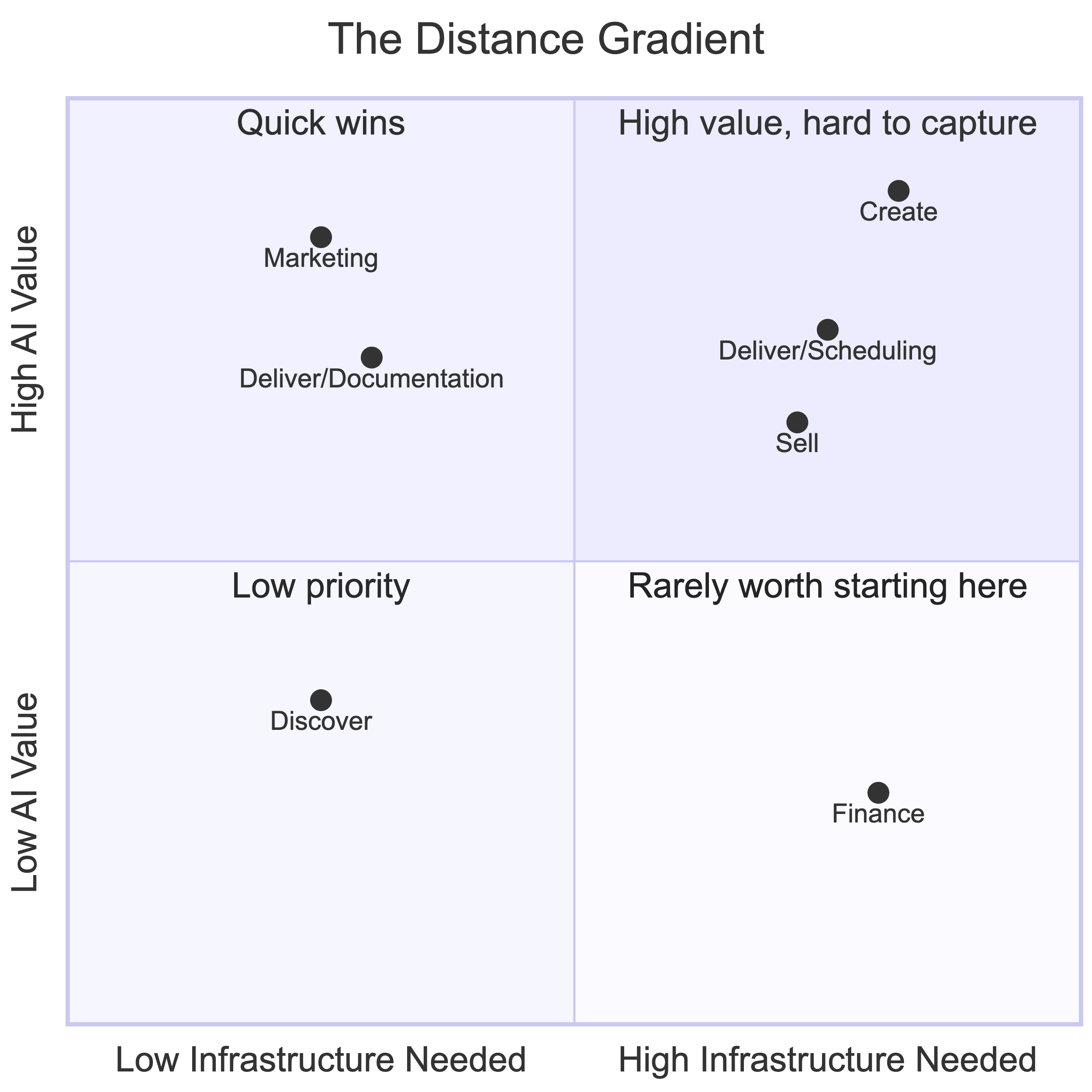
The functions where AI creates the most value for a manufacturer — Create and Deliver — are the same functions where the distance from Silicon Valley is greatest. The data is fragmented, the systems are legacy, and the knowledge is tacit. Meanwhile, the functions where AI is easiest to adopt are the ones where the impact on a manufacturer’s P&L is most modest.
This is the core tension. And up to 70% of SME AI initiatives are abandoned before reaching stable production, largely because companies start in the high-infrastructure quadrant without doing the groundwork.
Closing the Distance
The distance from Silicon Valley is not fixed. It closes every time someone in the shop learns to frame a problem in terms AI can actually help with.
Not “let’s use AI” — but “we lose 400 hours a year to unplanned downtime on these three machines, and we have eighteen months of maintenance logs. Is there a pattern?”
Start with Levels 1 and 2. Most manufacturing AI problems are either structured data problems or language problems. Treat it as a staged capital project — $50,000–$150,000 over two to three years, with explicit payback targets and kill criteria. And do the data plumbing first. Normalize your machine data. Standardize defect codes. Get your ERP and quality systems talking to each other. This work has value independent of AI.
The second question — the one about the maintenance logs — is the beginning of an AI strategy. The first one is just a phrase.
Sources
Brookings — AI Seems Everywhere, but Regional Readiness Is Uneven
MIT Sloan — The Productivity Paradox of AI Adoption in Manufacturing Firms
New Hampshire Department of Business and Economic Affairs — Advanced Manufacturing
New Hampshire Advanced Manufacturing Full Report (PDF)
NTT DATA — Between 70–85% of GenAI Deployment Efforts Are Failing to Meet ROI